The Sacred Philosophy Behind Bali's Traditional Keben Offering Basket
The keben, a woven bamboo vessel used across Bali's temples and ceremonies, carries deep spiritual meaning rooted in humility and sincere devotion. Its fitted lid conceals offerings to protect worshippers from judgment and allow them to pray with a pure heart.
The keben stands as one of the most recognizable symbols of Balinese religious life, appearing at virtually every temple ceremony and spiritual gathering across the island. This distinctive woven bamboo vessel serves a practical purpose, making it easier for devotees to transport the numerous items required for religious offerings, such as canang, kwangen, fruits, and flowers. Yet beneath its humble appearance lies a profound philosophical principle that reveals much about Balinese values and spiritual priorities.
The name keben itself holds the key to understanding its cultural significance. Scholars and cultural experts believe the word derives from the Balinese phrase engkebin, which means to conceal or to hide. This linguistic connection is far from coincidental. The keben's defining characteristic is its fitted lid, which serves a specific and deeply meaningful purpose in Balinese society. By concealing the contents of an offering from view, the keben protects worshippers from potential judgment or criticism based on the value or elaborateness of their gifts to the gods.
In a community where social standing and economic circumstances vary widely, this practical design becomes spiritually essential. A person bringing simpler offerings composed of humble local fruits may fear comparison with wealthier community members who present more elaborate and expensive contributions. Similarly, someone with greater means might feel obligated to display their prosperity through lavish offerings. The keben solves this dilemma by keeping all offerings private. Whether the basket contains local bananas or imported varieties, local citrus fruits or expensive Mandarin oranges, no one can know. As the Balinese say, sing ada nak nawang, no one will know.
This design philosophy reflects a cornerstone of Balinese Hindu spirituality: the belief that the quality of one's worship depends entirely on the purity and sincerity of the heart, not the material value of the offering. By hiding their contributions, worshippers can focus completely on their spiritual connection and prayer without concerns about how others perceive their devotion or financial circumstances. This allows them to approach temple ceremonies with the mental clarity and peaceful mind that authentic spiritual practice requires.
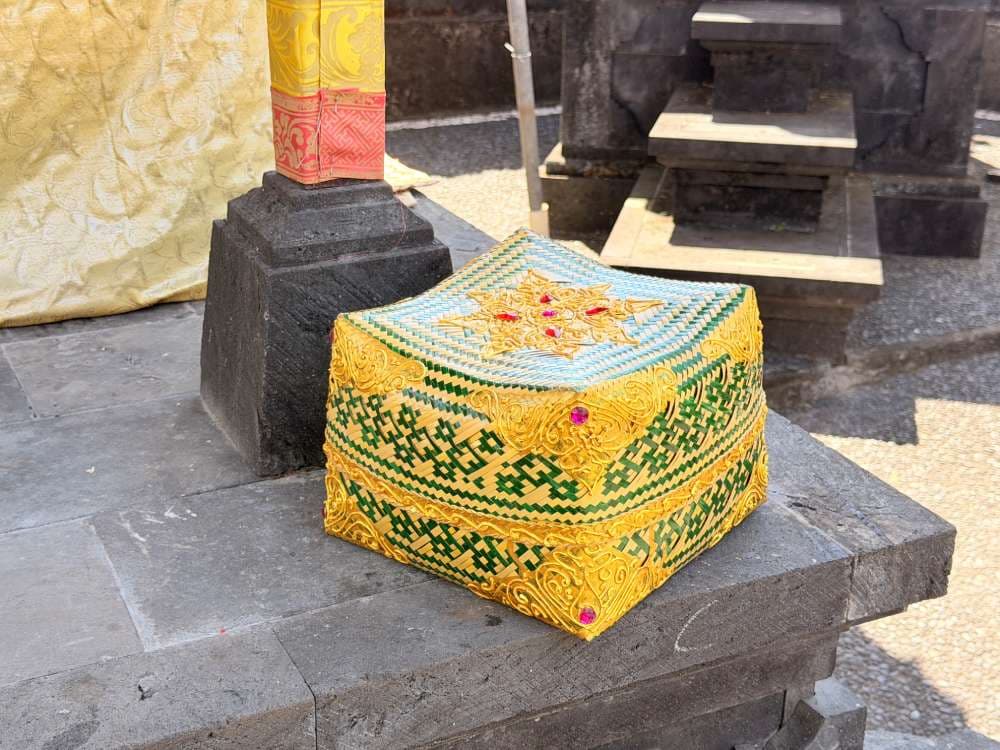
The construction of a keben demonstrates skilled craftsmanship developed over generations. Artisans weave together thin strips of high-quality bamboo so tightly that the finished vessel becomes remarkably sturdy despite the delicate materials. The durability of these woven containers allows them to safely hold the substantial weight of offerings without damage. It is worth noting that many people confuse the keben with a similar vessel called the sokasi, though the distinction is straightforward: the keben features a fitted lid, while the sokasi does not.
Modern creativity has expanded the traditional keben into a wider variety of forms and designs. Contemporary artisans now craft keben in numerous sizes and with diverse decorative motifs, ranging from traditional matahari sun patterns to Wayang Kamasan-inspired imagery. Many contemporary versions feature vibrant colors and even embellishments like sequins, allowing younger generations to maintain this important tradition while expressing personal aesthetic preferences. Despite these innovations, the fundamental philosophy of humble concealment remains unchanged.
The keben represents far more than a practical carrying vessel for temple offerings. It embodies essential Balinese spiritual wisdom about the true nature of worship and community harmony. In an increasingly materialistic world, this humble bamboo basket continues to teach visitors and residents alike that sincere devotion transcends financial capability, and that the most meaningful gifts come from a genuine and untroubled heart. For anyone seeking to understand the depth of Balinese culture, the keben offers a beautiful lesson in humility and spiritual authenticity.